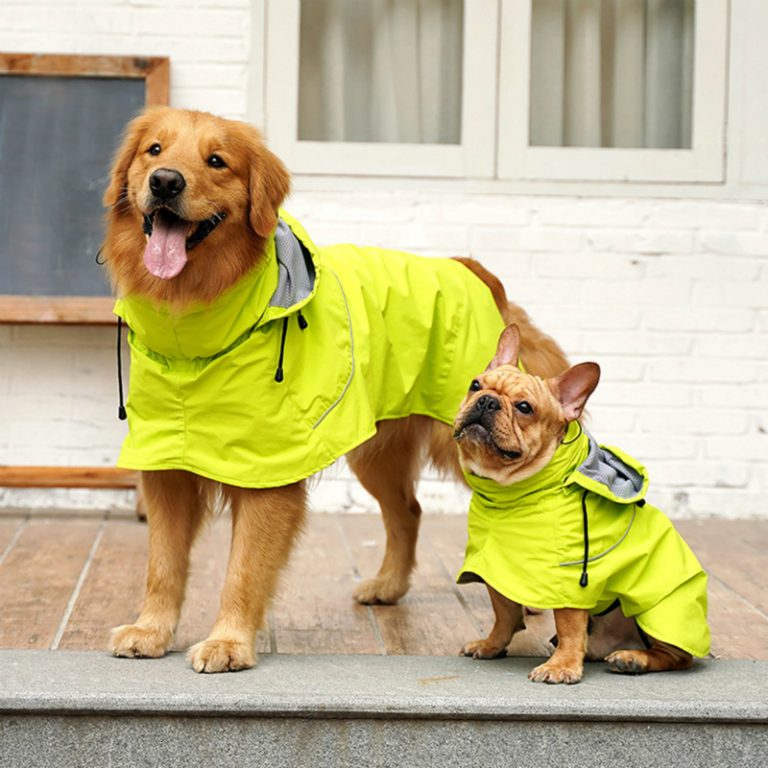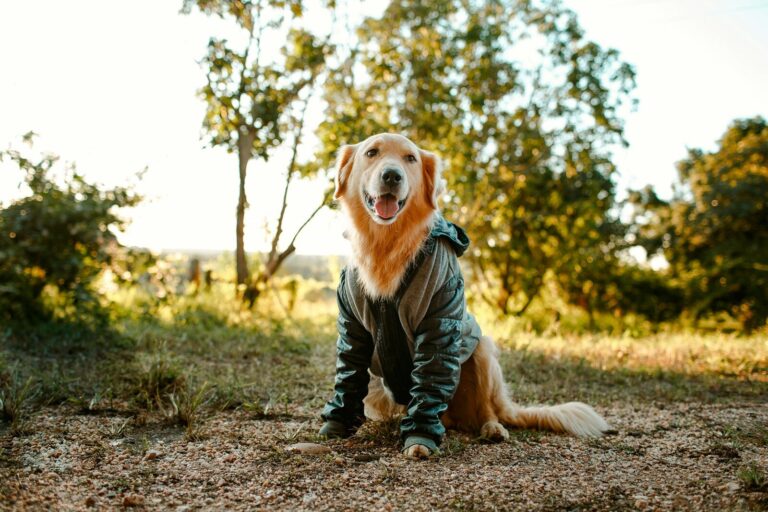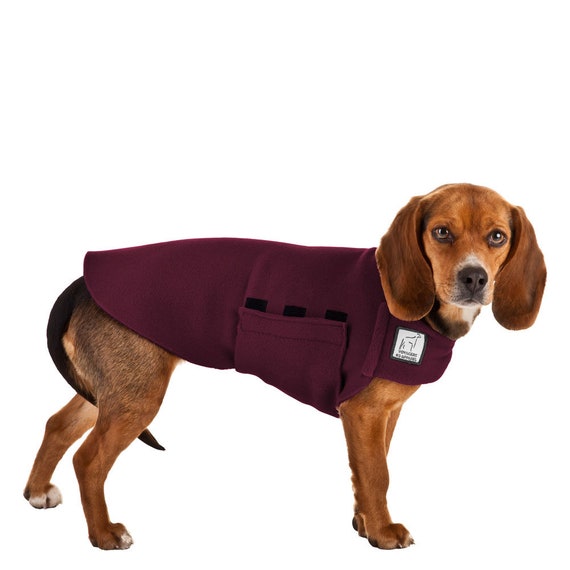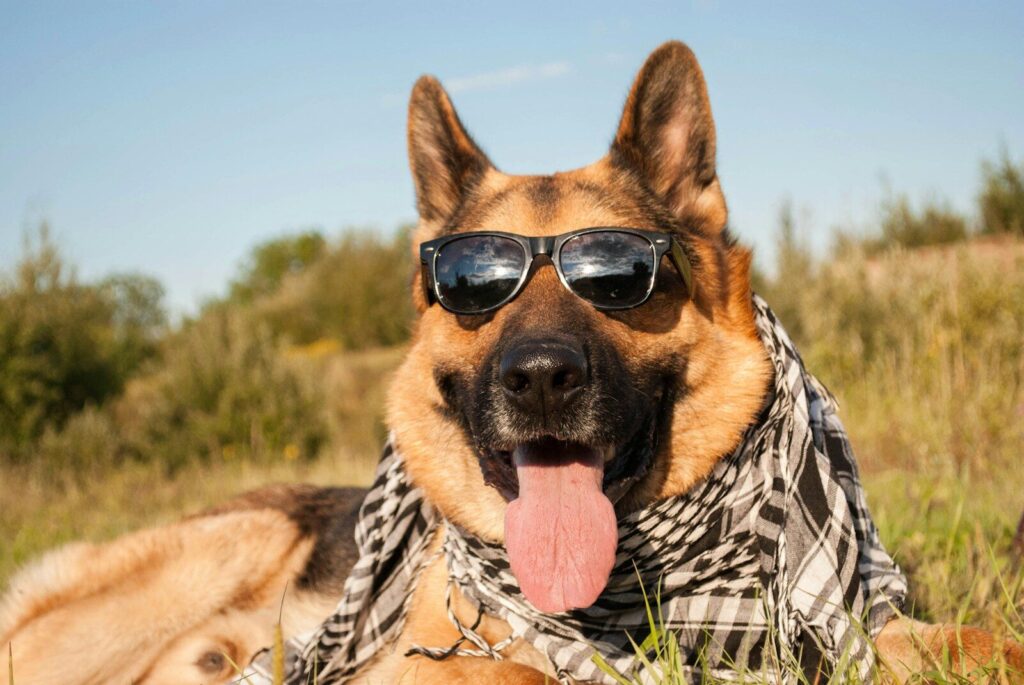
Dog clothes for German Shepherds are coats, full-body suits, raincoats, and vests cut for a large dog with a deep chest.
The right piece keeps a Shepherd warm below freezing and dry in rain, and the waterproof styles stop mud working into the undercoat on winter walks and outdoor training, without binding the legs or shoulders.
For most of the year a healthy adult Shepherd is fine without any of it.
The double coat does the job, often down to around -10°C before a working dog notices the cold.
Clothing pays off in a handful of narrower cases, and knowing which ones keeps you from buying gear the dog never wears.
When a German Shepherd needs clothing, and when it doesn't
The double coat handles most weather on its own, so the cases that call for clothing are worth knowing before you spend money.
Puppies under six months and older dogs lose heat faster and stiffen in the cold.
A dog recovering from surgery, or one whose coat has been clipped at the vet, has lost its insulation until the hair grows back.
Damp, slushy weather is harder on the breed than dry cold, because once the undercoat soaks through it stops holding heat.
And a sport or working dog that stands around waiting between drills cools down much faster than one that keeps moving.
The joints are the other reason.
Older Shepherds, and hard-working ones with years of jumps and turns behind them, feel cold in the big joints first, the shoulders and the hips.
A coat that covers the back and croup keeps those areas warm on a freezing morning and takes some of the bite out of stiff, arthritic days, especially when there's a draught.
The undercoat is built for cold, not for sitting wet for hours. It traps a layer of warm air, which works fine until a long icy rain pushes through it.
Past that point a soaked Shepherd in a cold wind loses heat quickly, and a waterproof layer is what stops it.
The risk runs the other way too. A thick suit worn all day, every day, works against the breed.
The double coat needs air to regulate temperature, and sealing it under fabric for hours traps heat and damp against the skin.
You end up with worn, matted guard hair, raw skin, and weeping sores, the hot spots a Shepherd's coat is already prone to.
Clothing is for the cold walk or the wet one, and then it comes off.
There's also a plain practical reason that has nothing to do with health.
A full-body suit on a wet walk means you hose the dog down once instead of running a full bath, which counts for something with a breed that sheds the way this one does.
Types of clothing by season and use
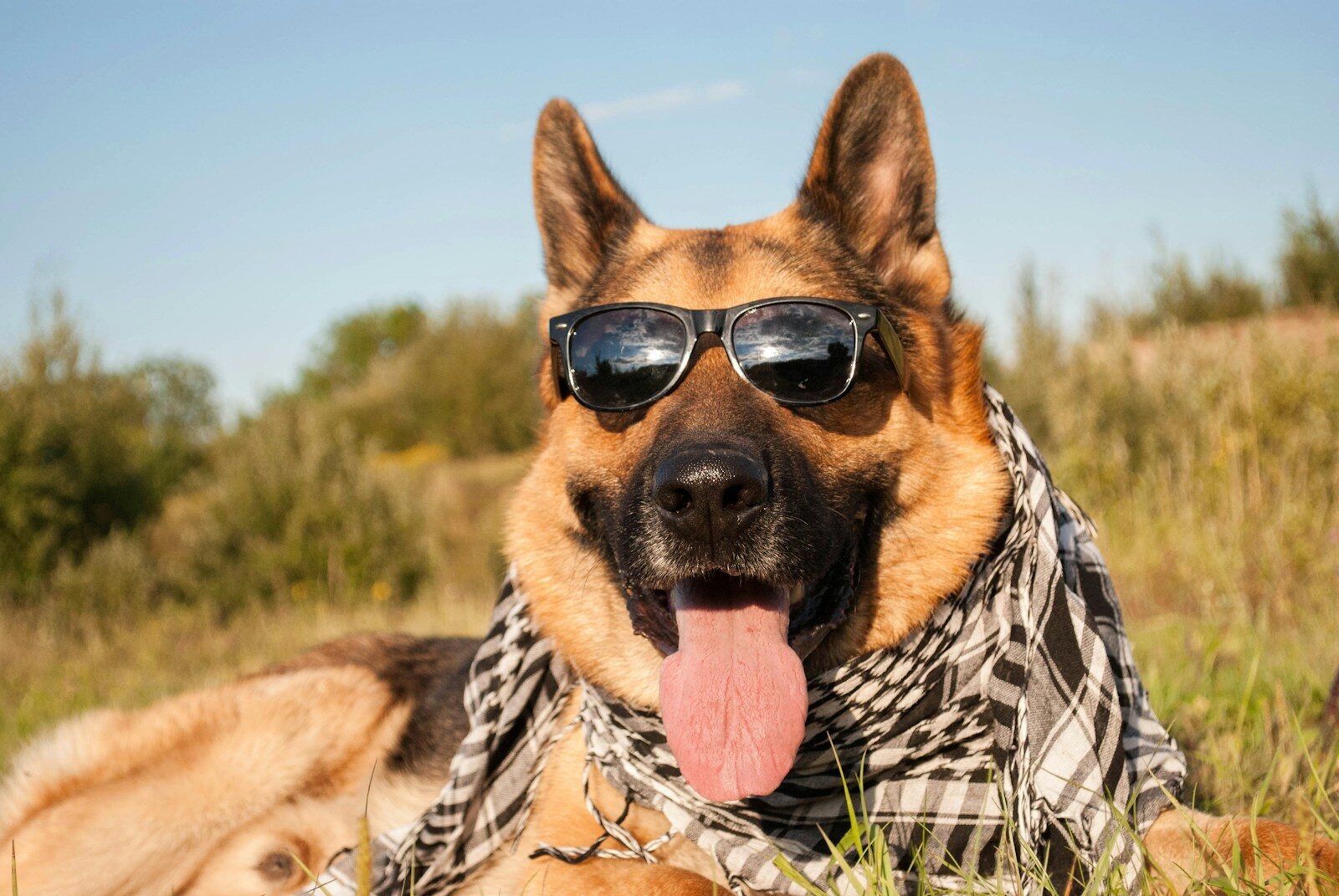
Four kinds cover nearly everything a Shepherd owner runs into.
- Mud suits and membrane raincoats handle wet weather. A full-body mud suit covers the legs and is the only thing that keeps a Shepherd properly clean through slush and puddles; a raincoat is lighter, skips the insulation, and just sheds water on a mild wet day.
- Winter coats and blankets cover the back and chest and buckle under the belly. They're for standing-still cold: waiting at training, a slow walk at -15°C, an old dog out on a hard frost. Most are fleece-lined or padded, and the warmth comes from the fill, not from how thick the coat looks.
- Tactical K9 vests are working kit. Built on a harness with Molle webbing, they carry patches, pouches, and a grab handle for lifting or holding the dog, and they suit training, tracking, and service work.
- Cooling vests do the opposite job. You soak them in water and they pull the dog's temperature down through summer training in open sun, where a Shepherd in a dark coat overheats fast.
Shop the dog drama
Quick exits to coats, collars, beds, crates, harnesses, leashes, muzzles, and grooming - now without the old image menu circus.
How the cut has to match a Shepherd's build
A Shepherd is awkward to fit because of its shape: a deep, broad chest, a long back, and a belly that tucks up sharply behind the ribs.
Clothing cut for other big breeds, a Labrador or a Great Dane, follows a different outline.
Size it to the Shepherd's chest and it sags around the lean waist; size it to the waist and it digs in across the chest and shoulders.
A cut that works for the breed has give where the dog is widest and adjustment where it's narrow.
Stretch panels across the chest let the garment sit close without squeezing. Wide adjustable straps under the belly pull the slack out at the waist.
For males, the belly line has to sit high and well back so the dog doesn't wet the fabric.
The front legs matter as much as the body. A Shepherd moves at a long, reaching trot, and the shoulder swings through a wide arc.
If the armholes are cut too small or too far forward, the coat binds at the first proper stride and the dog shortens its gait to cope.
The opening has to clear the shoulder through its full swing.
How to measure your dog, step by step
Three numbers off your own dog beat any size chart. Take them with the dog standing square on a flat floor, not sitting.
Back length runs from the base of the neck, the bump at the top of the shoulders, to the base of the tail.
Chest girth is the tape around the widest part of the ribcage, just behind the front legs, with a couple of fingers of slack so the dog can breathe and move.
Neck girth is measured low on the neck, where a collar sits.
| Measurement | Where the tape goes | Typical adult male |
|---|---|---|
| Back length | Base of neck to base of tail | 60-70 cm |
| Chest girth | Widest point behind the front legs | 75-90 cm |
| Neck girth | Where the collar sits | Measure your dog; varies widely |
Fit to the largest number, which on a Shepherd is the chest almost every time.
Then watch the dog move in the size you land on: it should walk, sit, and lie down without the fabric bunching under the front legs or dragging across the hips.
If a piece matches the chest but creeps up the back, take the larger size and rely on the straps to bring it in.
Materials and hardware that survive a Shepherd
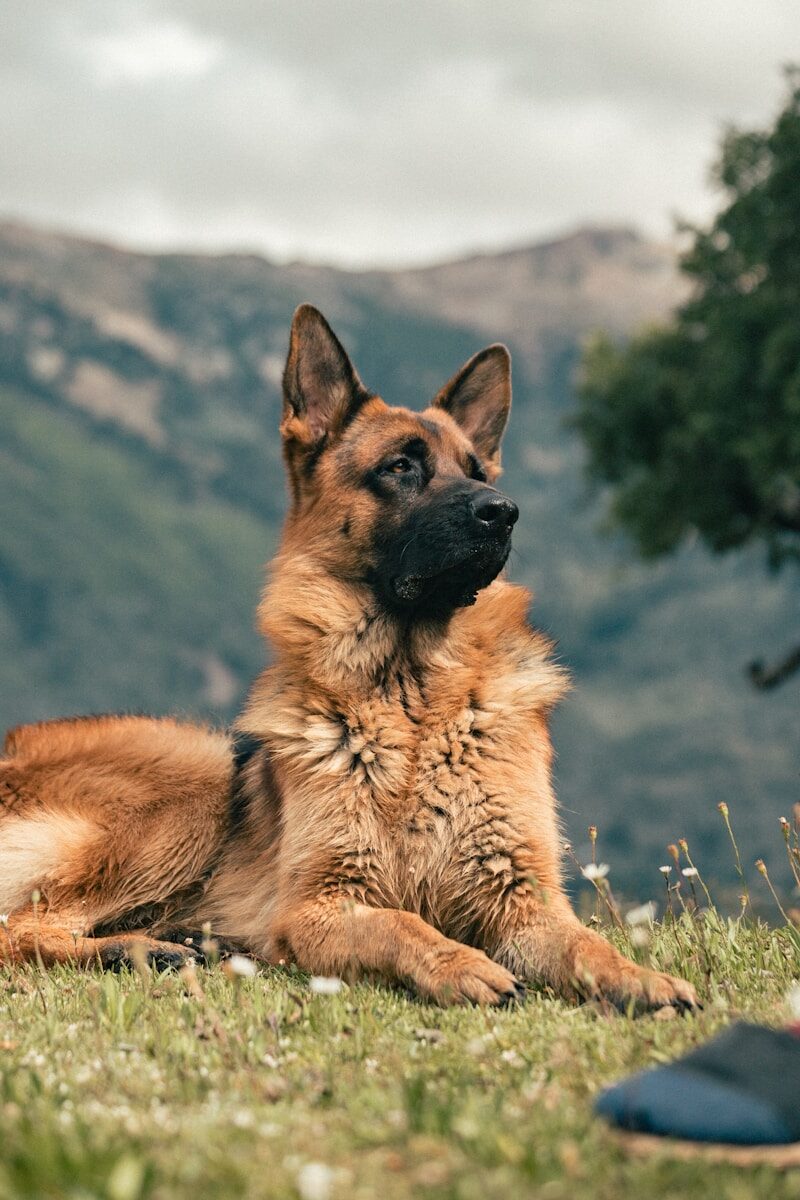
A Shepherd is an active, powerful dog, and cheap gear shows it fast. Two things separate a coat that lasts from one that doesn't: the fabric and the fastenings.
For anything the dog wears through brush or rough play, the outer fabric has to resist tearing.
Rip-stop nylon, Cordura, and Oxford weaves hold up to branches and claws far better than the thin shells on budget raincoats, which split the first time a Shepherd crashes through a hedge at speed.
On a waterproof piece, check that the seams are taped and the outer is coated, not just labelled water-resistant; water finds the stitching long before it soaks the fabric.
Inside, the lining has to breathe, or an active dog cooks in its own coat within minutes.
Fastenings are where the breed's coat causes the most trouble.
Open Velcro jams solid with shed hair within a month and stops gripping; ordinary zips catch the long guard hairs and snag.
Look for closed plackets over the zip, wide adjustable straps, and metal side-release buckles that a rolling, shoving dog can't pop open.
Reflective strips earn their place on a black dog walked in the dark.
And a fast closure beats a fiddly one: a Shepherd that won't stand still turns a three-buckle coat into a daily fight, so the simpler design is usually the better buy even if it looks less impressive.
Getting a strong dog used to wearing a suit
A full-body suit with legs is a lot to ask of a grown working dog that's never worn one.
Pushed too fast, a strong, wary Shepherd can tip into stress or snapping, so the introduction goes in stages, with food and patience.
Start small. Let the dog sniff the suit, then feed treats while it's just lying nearby, so the thing predicts good news rather than a wrestling match.
Next, put on a legless blanket, the kind that only covers the back and clips under the belly.
It restricts the body the least, and most dogs accept it inside a session or two.
Only once the blanket is a non-event do you move to a suit with legs.
Slide one leg on, treat, take it off; build up a leg at a time across several short sessions.
Watch the dog the whole way.
A hard stare, stiffening, lip-licking, or trying to chew the fabric off all mean you went a step too quick, so drop back to the stage it was happy with and slow down.
Done right, even a serious working dog ends up standing still to be zipped in.
Questions owners ask
Does a German Shepherd get cold outside in winter? Rarely, if the dog is a healthy adult.
The double coat handles temperatures down to around -10°C, and many cope with worse while they're moving.
Cold becomes a problem when the dog is wet, standing still for long stretches, very young, old, or recently clipped.
A dog that shivers, lifts its paws off the ground, or wants to head home has had enough and should be warmed up or taken in.
How often can you put a raincoat on a Shepherd? As often as the weather calls for it, with one caveat.
A raincoat for the length of a wet walk is no problem.
The issue is leaving any close layer on for hours at a stretch, because the coat needs air to manage its own temperature.
Put it on for the walk, then take it off and let the dog dry out at home.
What if my dog falls between XL and XXL? Go up, then adjust down.
A Shepherd between sizes almost always has the chest pushing it into the larger band, and the chest is the measurement you fit to.
Take the bigger size and use the belly and chest straps to pull in the slack.
Forcing the smaller size leaves the chest squeezed and the shoulders bound, which is the one fit error a deep-chested dog won't tolerate.
How do you care for membrane clothing after a muddy walk? Rinse the worst of the mud off before it dries, then wash on a gentle cycle with no fabric softener, since softener clogs the membrane and kills the water-repellence.
Let it air-dry rather than putting it on a hot radiator.
When water stops beading on the surface, re-proof the outer with a spray or wash-in product, usually once or twice a season.
Check the straps and buckles every few weeks too, because on a hard-used suit the fastenings give out before the fabric does.