Clothing for a Rottweiler is a practical question first, a style question second.
The breed has a short double coat, a broad barrel chest, and a body that sits well outside what most dog clothing manufacturers treat as "large."
Getting the right garment means measuring the dog accurately, understanding when clothes are actually useful, knowing which designs are safe, and recognizing that most sizing charts weren't written with a 110-pound Rottweiler in mind.
Direct answer
The three measurements that determine fit are chest girth (the widest point of the chest, taken just behind the front legs), back length (from the base of the collar to the base of the tail), and neck girth (where the collar sits).
Chest girth is the controlling measurement.
A typical adult male Rottweiler has a chest girth in the range of 32 to 38 inches; a female runs roughly 28 to 34 inches.
Most garments labeled XL or XXL at mainstream pet retailers were designed for dogs in the 50 to 70 pound range.
A Rottweiler at 100 to 130 pounds often needs XXXL or larger, and even then may require a brand that specifically builds for deep-chested breeds.
The Rottweiler's body and why standard sizing fails
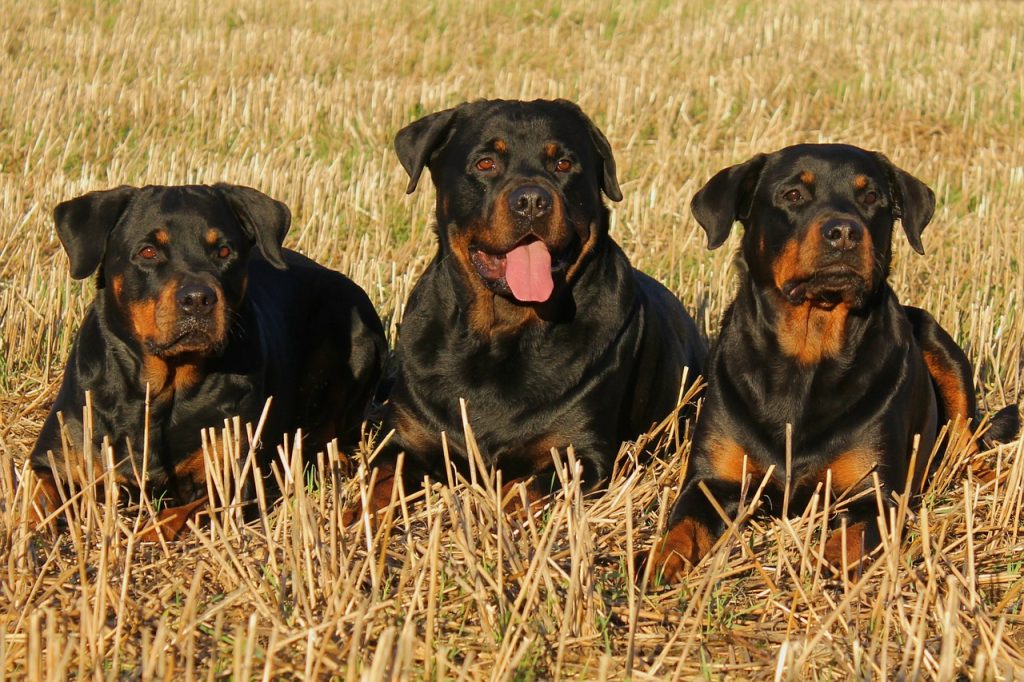
According to the American Kennel Club breed standard, adult male Rottweilers stand 24 to 27 inches at the shoulder and weigh 95 to 135 pounds; females stand 22 to 25 inches and weigh 80 to 100 pounds.
Body length from breastbone to hindquarters runs 73 to 76 cm in males and 69 to 71 cm in females.
Chest depth (the distance from the top of the withers to the base of the breastbone) is roughly 50% of withers height, which means a male at 26 inches at the shoulder has a chest that is about 13 inches deep.
Chest width across the shoulder blades runs 33 to 34 cm in males and 31 to 32 cm in females.
That combination of deep chest, wide shoulders, and short back creates a shape that generic size charts handle poorly.
A Rottweiler might fit a XXXL in chest girth, but the same garment's back length may come out too long, covering the hindquarters and causing the fabric to bunch or ride up during movement.
The prosternum (breastbone) on a Rottweiler is large and prominent.
Straight-across chest straps on coats and sweaters can press against the scapula and restrict shoulder movement.
Brands that build for flat-chested or narrow-chested large breeds often produce clothing that pulls tight across the chest or rides up on the sides.
Shop the dog drama
Quick exits to coats, collars, beds, crates, harnesses, leashes, muzzles, and grooming - now without the old image menu circus.
When clothes are useful and when they aren't
Healthy adult Rottweilers with a full, intact double coat generally regulate temperature well enough that clothes are not needed for warmth in moderate cold.
The breed originated in Germany's continental climate and retains a functional undercoat that thickens seasonally.
One Rottweiler breeding kennel in Serbia with continental winter temperatures around 0°C noted that the coat thickens naturally and that adding a sweater over it is typically more uncomfortable than useful for a conditioned adult dog kept outdoors.
That said, several situations do justify clothing.
Puppies under six months haven't fully developed thermal regulation.
Their core temperature drops faster, and they benefit from a lightweight layer during cold-weather outings.
Rottweiler puppies grow fast and will outgrow any garment quickly, so sizing up at purchase is reasonable.
Senior dogs, dogs recovering from surgery, and dogs with conditions like hip or elbow dysplasia may have difficulty generating enough body heat during outdoor exposure.
Rottweilers are genetically predisposed to hip and elbow dysplasia, and cold temperatures increase the viscosity of synovial fluid, which can worsen joint stiffness.
A well-fitted coat reduces that exposure.
Dogs that have been kept indoors for most of their lives, who have thinner undercoats due to being kept in heated environments year-round, lose some cold tolerance compared to dogs that spend more time outside.
The same applies to any Rottweiler with a thinner-than-typical undercoat due to genetic variation.
Wet conditions present a separate problem.
The outer guard hairs on a Rottweiler resist light moisture, but once the undercoat becomes saturated in temperatures below about 38°F (3°C), it stops insulating and starts pulling heat away.
A water-resistant shell coat is genuinely useful in rain or sleet at low temperatures, even for a healthy adult.
Indoors, in a heated home, clothing is unnecessary for warmth.
Putting a thick coat on a Rottweiler inside can cause overheating, which shows as heavy panting, excessive drooling, and lethargy.
A light layer worn briefly, or worn for decorative reasons during supervised time, is fine.
A heavy insulating coat indoors is not.
How to take the three key measurements
Stand the dog on a flat surface without leaning or sitting.
Chest girth: Wrap a soft tape measure around the widest part of the chest, which is typically just behind the front legs.
Pull the tape snug but not tight. You should be able to slide two fingers under the tape without effort.
This is the number that controls sizing for most garments.
Back length: Measure along the spine from the base of the neck (where the collar sits) to the base of the tail.
Don't include the tail. This measurement tells you whether a garment's length is appropriate. The garment should end at or just before the base of the tail.
Fabric that extends past the tail will bunch and shift during movement, which most dogs find irritating.
Neck girth: Measure around the neck where the collar rests. Again, use the two-finger rule. This matters most for sweaters and anything that goes over the head.
When a dog falls between two sizes on a manufacturer's chart, size up.
A slightly larger garment that allows full movement is safer and more comfortable than a snug one that restricts the shoulders or rides up.
Fabric and design safety
Chest opening shape: Because Rottweilers have a large prosternum, look for garments with a Y-shaped or curved chest panel rather than a straight horizontal strap.
A straight strap across the chest can press against the shoulder blades and alter the dog's gait.
Over time, that kind of restriction can contribute to joint discomfort in a breed already prone to orthopedic issues.
Belly opening: Male Rottweilers need a garment with a higher cutout around the groin and lower abdomen so the dog can urinate without soiling the clothing.
Most sweater-style garments have open bellies by default, but jumpsuit-style designs may not.
Check the design before buying.
Closures: Velcro closures are the easiest to put on and adjust. Snaps and buckles work but are slower.
Avoid garments that require pulling multiple limbs through tight holes, especially for a dog that isn't used to wearing clothes.
Hardware and decorations: Small buttons, dangling pom-poms, loose decorative strings, and metal studs are choking hazards.
If a Rottweiler manages to chew off a button or zipper pull, the piece can cause an intestinal blockage.
Zippers themselves can also catch on crate bars or furniture hardware and trap the dog.
Designs with minimal attached hardware are safer.
Loose knits and mesh: These fabrics can snag on the dog's nails or on furniture and pull apart, creating entanglement risks.
A fleece or tightly woven cotton-polyester blend holds its shape better and is harder to snag.
Fabric breathability: Dense synthetics like high-elastane blends trap heat. Fleece is warm but works best in cold outdoor conditions, not indoors.
For indoor wear, light cotton blends or thermal knits with some stretch work better.
Wool is warm but can irritate some dogs' skin, particularly around the neck. Acrylic-wool blends often work better than pure wool.
Fitting the garment and supervising wear
The garment should lie flat along the back without pulling toward the head or bunching toward the tail.
The dog should be able to walk, sit, lie down, turn its head, and go to the bathroom without restriction.
If the dog freezes in place when clothed, walks differently, or repeatedly tries to remove the garment, it doesn't fit or the dog is distressed.
Dogs should always be supervised while wearing clothes. AKC guidance on dog clothing is explicit: don't leave garments on a dog that is crated or unattended.
A caught sleeve or a garment that shifts and tightens around the neck can be dangerous when no one is present to intervene.
At home, this means removing the garment before leaving the room for extended periods, before the dog goes into a crate, and before bedtime.
Introduce clothing gradually. Put the garment on the floor and let the dog sniff it.
Drape it across the dog's back briefly, then remove it and reward with a treat.
Increase duration over several sessions. A quiet room in the house with minimal distractions is the right place for the first few times.
Check the skin under the garment after each use, especially around the neck, armpits, and anywhere the fabric fits snugly.
Redness, rashes, or patches of flattened fur indicate that the garment is rubbing or trapping moisture.
Practical visitor implications for home use
For a Rottweiler living as a home dog, the most useful garments are:
A water-resistant shell coat for outdoor use in wet, cold weather. This is the item with the most genuine functional benefit.
Look for a harness-compatible opening on the back so you don't have to choose between the coat and the harness on walks.
A light fleece or thermal layer for puppies, senior dogs, or dogs recovering from illness or surgery during cold months indoors or on short outdoor breaks.
A post-surgery or recovery vest (sometimes called a surgical suit) to protect sutures or treated skin areas.
Veterinarians sometimes recommend these after procedures to prevent the dog from reaching the wound.
Decorative or costume clothing, if used, should be lightweight, fit properly, have no small attachments, and be worn only during supervised periods.
Remove it when the dog is left alone, even briefly.
Common misconceptions
Weight is not a substitute for measurement. A 100-pound Rottweiler and a 100-pound Labrador have significantly different body shapes.
Rottweilers are broader-chested and shorter-bodied relative to their mass. Buying by weight class alone produces poor fits.
"Large breed" on the packaging doesn't mean Rottweiler. Most pet retail clothing lines label XXL for dogs up to roughly 65 to 70 pounds.
A Rottweiler at 110 pounds needs to go several sizes beyond that. Verify the brand's actual chest girth range for each size, not just the letter label.
A healthy coat doesn't mean a Rottweiler can never feel cold. The undercoat's insulating value depends on the individual dog's coat density, whether the coat is wet, the temperature, wind chill, and how much the dog is moving.
A dog that has been indoors all winter and goes outside in wet, windy conditions at 28°F is not in the same position as a kennel dog that has been out daily through the season.
Current status
There is no regulatory standard for dog clothing sizing as of mid-2026.
Each manufacturer publishes its own charts, and the same chest girth may correspond to different size labels across brands.
Measuring the dog and then checking the specific brand's chart for that product is the only reliable approach.
Return and exchange policies vary. Buying from retailers with size-exchange options is practical for a breed as difficult to size as the Rottweiler.
References
Primary and organizational sources
- American Kennel Club, Official Standard of the Rottweiler: https://images.akc.org/pdf/breeds/standards/Rottweiler.pdf
- American Kennel Club, dog clothing and weather safety: https://www.akc.org/expert-advice/advice/dog-clothes-weather-safety/
- Dimensions.com, Rottweiler dimensions: https://www.dimensions.com/element/rottweiler-dog