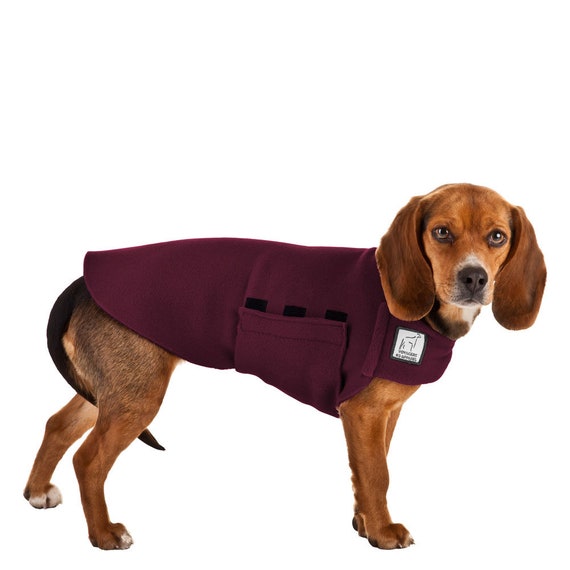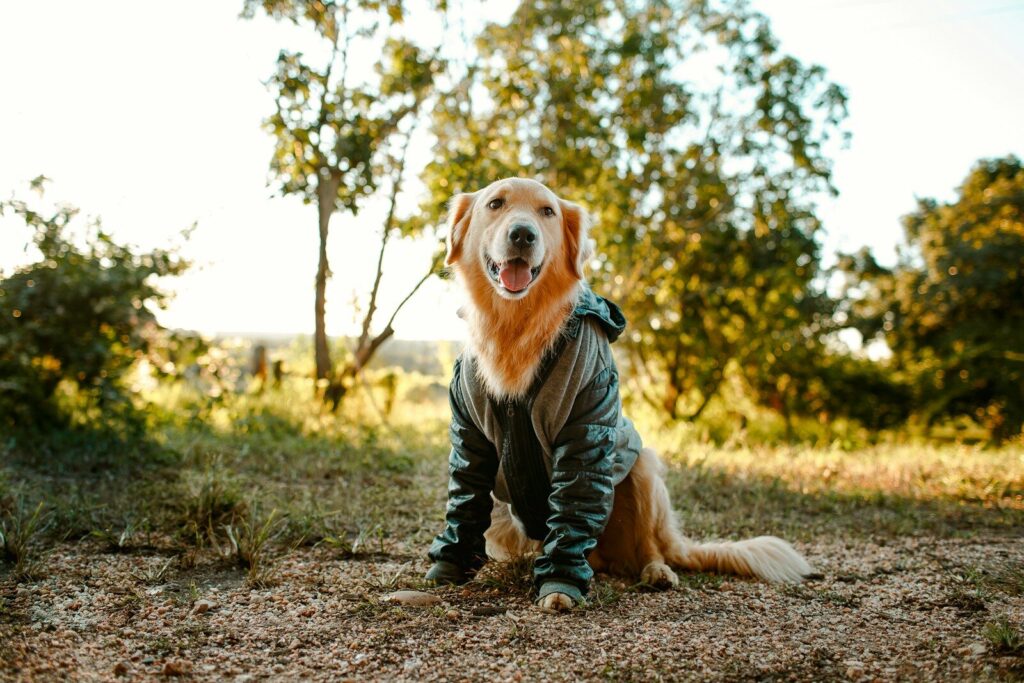
Golden retrievers need clothes in specific conditions, not by default. A healthy adult in full coat handles cold, light rain, and moderate snow without gear.
An older dog with arthritic joints, a dog recovering from surgery, or any golden walking on salted winter pavement in below-freezing temperatures has real reasons to wear a coat or suit.
The double coat protects against cold but does nothing to prevent mud matting, ice ball formation between the toes, or chemical burns from road deicers.
Why a golden retriever might actually need clothes
Keeping that coat clean
The feathering on a golden's legs, belly, chest, and tail collects everything: mud, burrs, ice balls, road salt.
After a wet walk, the coat can take two to three hours to dry fully, and that damp period is when tangles and mats form fastest, especially on the leg fringing and behind the ears.
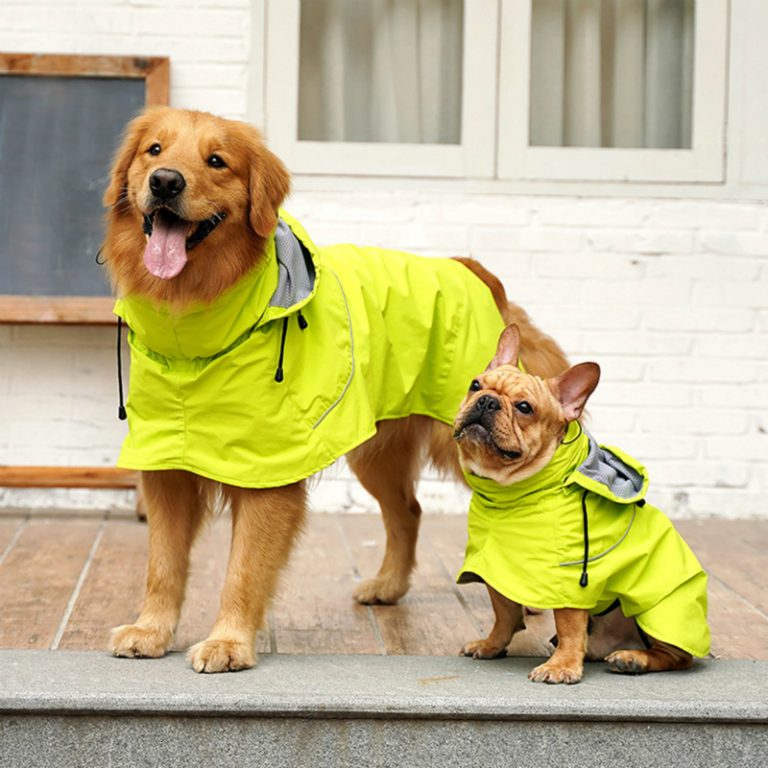
A fitted raincoat that covers the belly and lower legs cuts drying time and means brushing out one clean coat instead of picking ice chunks out of leg fur for 20 minutes.
When goldens get cold
A healthy adult golden in good coat handles temperatures down to about 45°F (7°C) without issue on a normal-length walk.
Below that, or in wind and rain, the calculation changes.
An older dog with arthritis or hip dysplasia feels it faster: cold stiffens already-inflamed joints, and the dog will start shortening its stride or refusing steps after 10 to 15 minutes outside even in mild cold.
Dogs who live indoors are more sensitive than working dogs kept outside year-round.
An apartment-dwelling golden going from 72°F inside to 20°F outside is a different case entirely.
Ice, snow, and road salt
Packed snow between the toes is a real problem for goldens.
The feathering on the paws holds snow, which compresses into ice balls and cuts into the skin between the pads.
Road salt and chemical deicers cause burns and get licked off during grooming.
A bodysuit that covers the belly prevents ice from loading up on belly fur, which can accumulate so heavily it causes cold-related skin irritation along the abdomen.
Types of clothes worth buying for a golden
Raincoats and mud suits
A good raincoat for a golden needs a membrane fabric: waterproof on the outside, breathable enough that the dog doesn't overheat while moving.
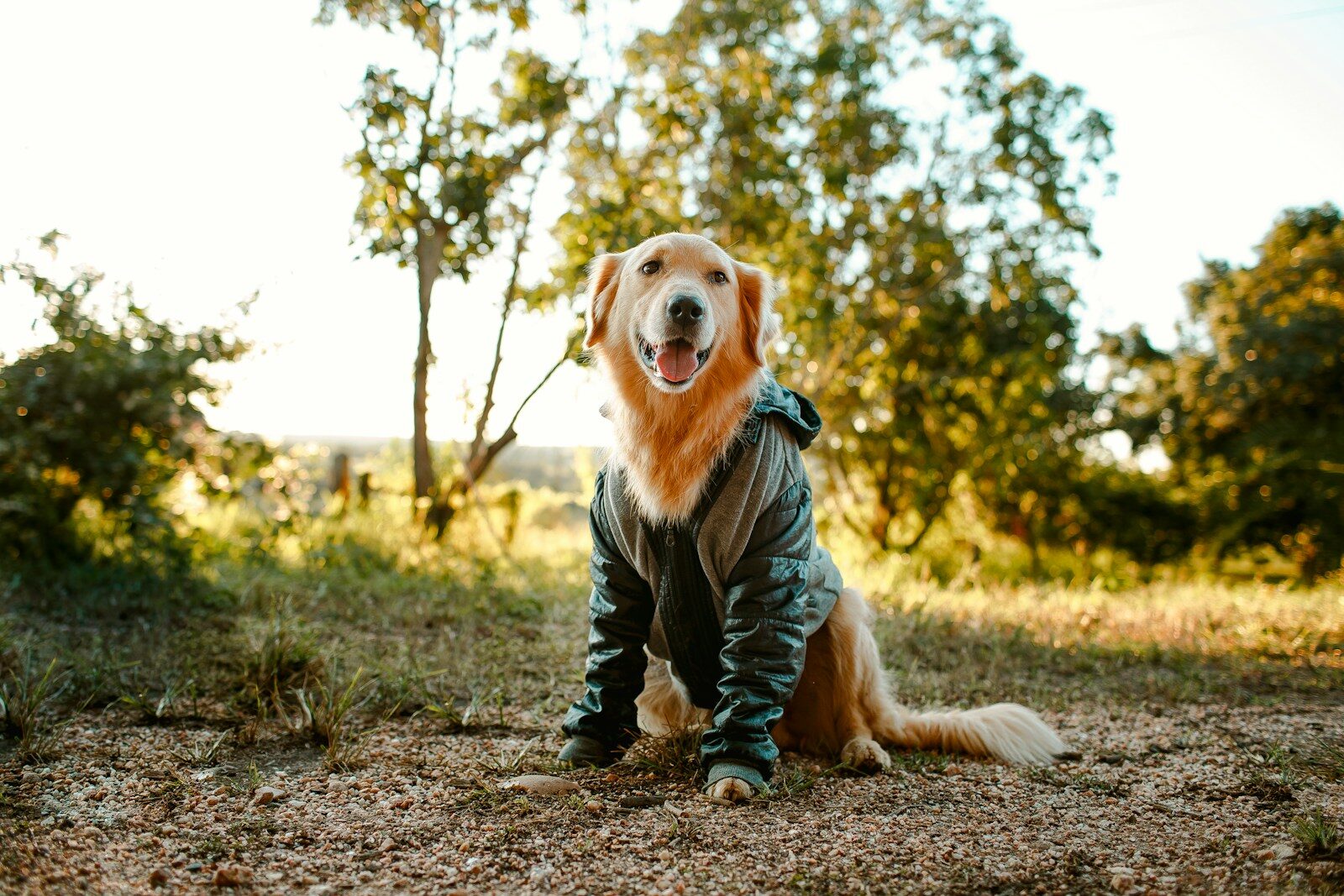
Belly coverage matters. A cape-style coat that only covers the back is largely useless because the belly and legs are what get soaked.
Full-coverage suits that cover the legs as well as the torso are the most practical for muddy conditions, though they take longer to put on and most goldens need a few sessions to get comfortable in them.
The zipper placement deserves attention: a zipper running along the back of a long-coated dog will catch the outer guard hairs.
Covers for the zipper track, snap closures, or wide velcro closures are better options for this breed.
Winter blanket coats and insulated vests
For cold-weather use, a blanket-style coat that wraps around the dog's torso without restricting shoulder movement is the most practical design.
Goldens are active dogs, and a coat that pulls at the shoulders mid-run either gets torn or makes the dog move awkwardly.
Insulated vests that leave the legs free work well for dogs who don't need full-leg coverage but get cold in their core.
They're also easier to manage on a dog who won't stand still.
Cooling vests for summer
Dense undercoats trap heat.
A golden that spends 45 minutes in direct sun at 90°F is at real risk of heat exhaustion, and the same coat that insulates in winter does nothing to release heat in summer.
Evaporative cooling vests hold water against the dog's body; as it evaporates, it carries heat away.
Soaking the vest in cold water before a long walk in warm weather makes a measurable difference.
Post-surgery bodysuits
After abdominal or chest surgery, a fitted bodysuit is easier on the dog than an Elizabethan collar.
The dog can move, eat, drink, and sleep normally, and the incision stays covered without the collar banging into furniture.
Most vets will approve this for external incision protection; confirm before switching.
Shop the dog drama
Quick exits to coats, collars, beds, crates, harnesses, leashes, muzzles, and grooming - now without the old image menu circus.
How to measure a golden retriever for clothes
Golden retrievers have wide variation in build. A 65-pound female and a 90-pound male are both goldens, and their measurements will be completely different.
Weight alone gives you nothing usable. You need three measurements:
- Back length: from the base of the neck (where a collar sits) to the base of the tail, with the dog standing on a flat surface, not sitting.
- Chest girth: at the widest point of the chest, just behind the front legs. For goldens with heavy coats, add 3 to 5 cm to the tape measure reading to account for coat compression. Clothes that fit the coat but not the body will pull or restrict movement.
- Neck circumference: measured where a wide collar would sit. This is the tightest point most coats pass over and the measurement that causes the most sizing problems when ignored.
Common mistakes: relying on breed size charts ("golden retriever, size L"), ignoring coat density, and using the dog's weight as a proxy for chest measurement.
A 70-pound golden with a heavy winter coat needs a bigger chest measurement than a 70-pound golden in summer coat.
What to look for in materials and hardware
Ripstop nylon holds up to brush, branches, and fence-catching that goldens generate on active walks.
Softer fabrics pill and tear within two months on an active dog.
Reflective piping or stitching along the edges matters if the dog walks at dawn, dusk, or after dark.
A 70-pound dog moving through traffic or parking lots at low light needs to be visible from a distance.
Avoid exposed metal zippers on the back of the coat. The guard hairs on a golden's back are long and stiff enough to jam a zipper reliably.
If the coat you like has a back zipper, look for a version with a protective flap over the zipper track.
Frequently asked questions
How do you get an adult golden used to wearing a coat?
Start with short indoor sessions, five minutes with no pressure.
Let the dog wear the coat during something it already likes, eating or playing, so the association is positive.
Build up to longer indoor sessions before adding the variable of a walk. Most dogs stop fighting the coat within a week of consistent, low-pressure exposure.
If the dog is still visibly distressed after two weeks, check that the fit is right before concluding the dog just won't tolerate clothes.
Is it safe to leave a golden in a coat in a parked car?
A winter coat left on a dog in a warm or sealed car creates a heat risk faster than most owners expect.
Even at 60°F outside, a parked car heats up quickly. If you're making a stop where the dog stays in the car, take the coat off while the dog waits.
This goes double for insulated coats and full-coverage suits.
How do you wash a waterproof raincoat without ruining the membrane?
Machine wash cold on a gentle cycle with a technical fabric cleaner like Nikwax Tech Wash.
Skip fabric softener entirely: it coats the fibers and kills breathability.
Tumble dry on low or air dry, then re-treat the outer face with a DWR (durable water repellent) spray if water no longer beads off the surface.
A coat that soaks through instead of shedding water has lost its DWR treatment, not its membrane, and re-treating costs about five dollars.