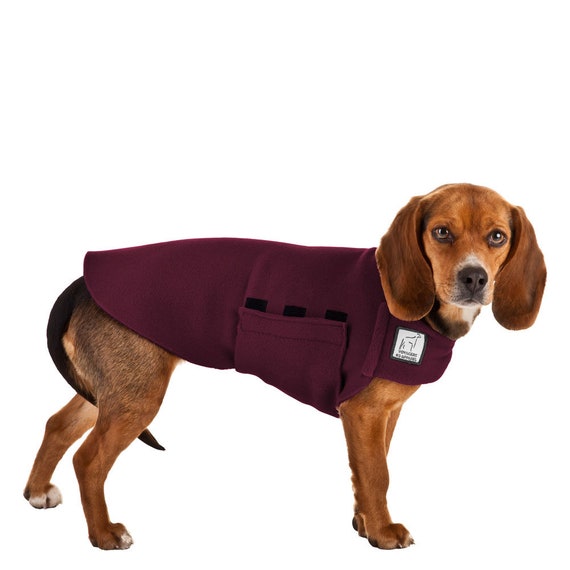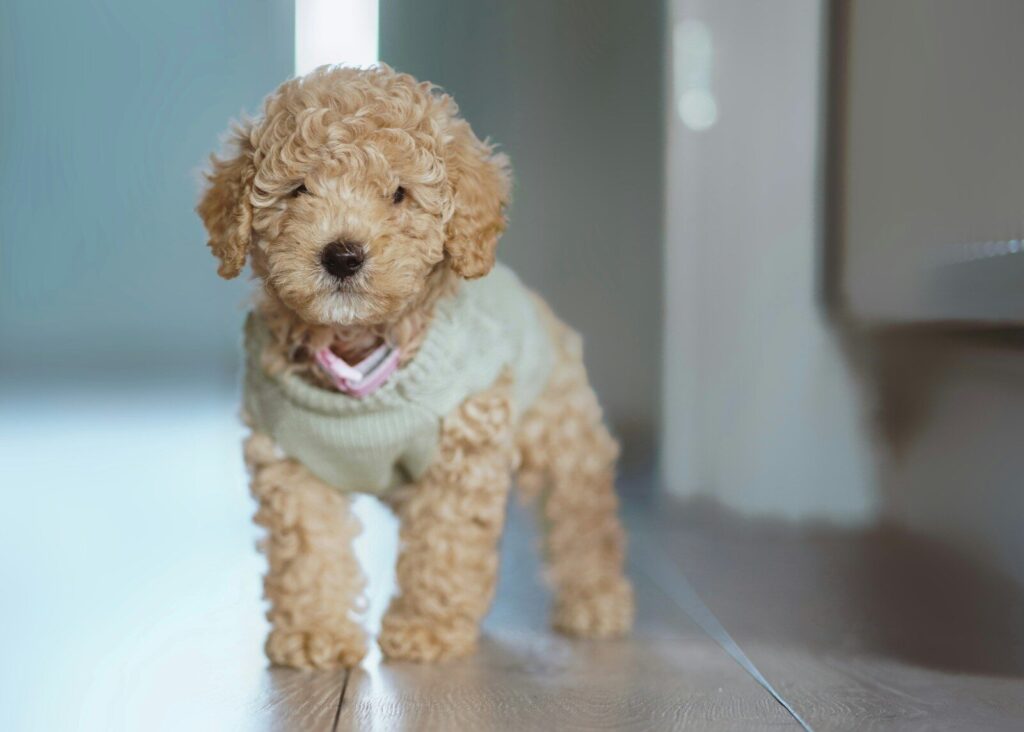
Poodles come in three AKC-recognized sizes, each with the same distinctive curly coat and the same body proportions: deep chest, narrow waist, long legs, and high tail set.
Poodles are deep-chested dogs with a small waist, which is why clothes made for other breeds often don't fit.
That structural reality is the starting point for any clothing decision. Getting the fit right takes more than picking a size off a general chart.
Direct answer
Choosing clothes for a Poodle at home comes down to four things: whether the dog actually needs the garment, accurate measurements taken in three specific spots, fabric that won't mat the curly coat, and a fit that passes a movement test.
The breed's body shape makes generic sizing unreliable, and the wrong fabric will turn a daily sweater into a grooming problem.
When a Poodle at home actually needs clothes
The question of whether to dress a Poodle indoors has a practical answer that depends on the dog's size, age, coat length, and the temperature of the home.
Toy Poodles are known to have trouble regulating body temperature due in part to having very little fat reserves.
Signs are shivering and shaking, and these are sometimes mistaken for nervousness.
A lightweight sweater or shirt can fix this.
Some owners never realized how uncomfortable their Poodle was in the winter until a sweater was slipped onto the dog, causing an almost instant physical relaxation.
It is never normal for a Poodle to shiver.
If your home's temperature is regulated to between 70 and 78 degrees Fahrenheit, the need for your dog to wear a coat or jacket diminishes.
Below that range, especially for Toy and Miniature Poodles, a light indoor layer is often genuinely useful.
If you like to keep your home on the chillier side, keep your pup warm with a cozy indoor sweater.
Dogs that tend to have short-cropped hair, like Poodles, which may grow thick hair but which owners tend to keep short to avoid matting, should also be given a sweater to protect them from very low temperatures.
Also, older dogs with weaker immune systems and dogs with diseases that impair hair growth typically need an extra source of warmth, and this can be easily provided by a sweater or jacket, even indoors.
Coat length matters too. A Poodle kept in a short clip has less insulation than one with several months of growth.
If the coat is long, indoor clothing is usually unnecessary except for elderly dogs or dogs recovering from illness.
Shop the dog drama
Quick exits to coats, collars, beds, crates, harnesses, leashes, muzzles, and grooming - now without the old image menu circus.
Poodle body shape and why standard sizing fails
All three Poodle varieties share the same proportions. The Standard Poodle stands over 15 inches at the shoulder; most are in the 22-27 inch range.
The Miniature is over 10 and not over 15 inches at the shoulder; most are in the 13-15 inch range.
The Toy stands 10 inches or under. The weight ranges are: Toy, 4-6 lbs; Miniature, 10-15 lbs; Standard, 40-70 lbs.
The shared body type is what creates the fit problem. When the shape is wrong, the fabric has to go somewhere.
It pulls, shifts, and rotates to release that tension.
That's why a coat can look right when your dog is standing but fail the moment your dog starts moving.
With Miniature Poodles, sometimes you have to buy things sized small and sometimes sized medium because of this poodle shape.
Going by weight or breed category alone produces this inconsistency. The measurements you take from the actual dog are what matter.
How to measure a Poodle for clothes
The dog must be standing.
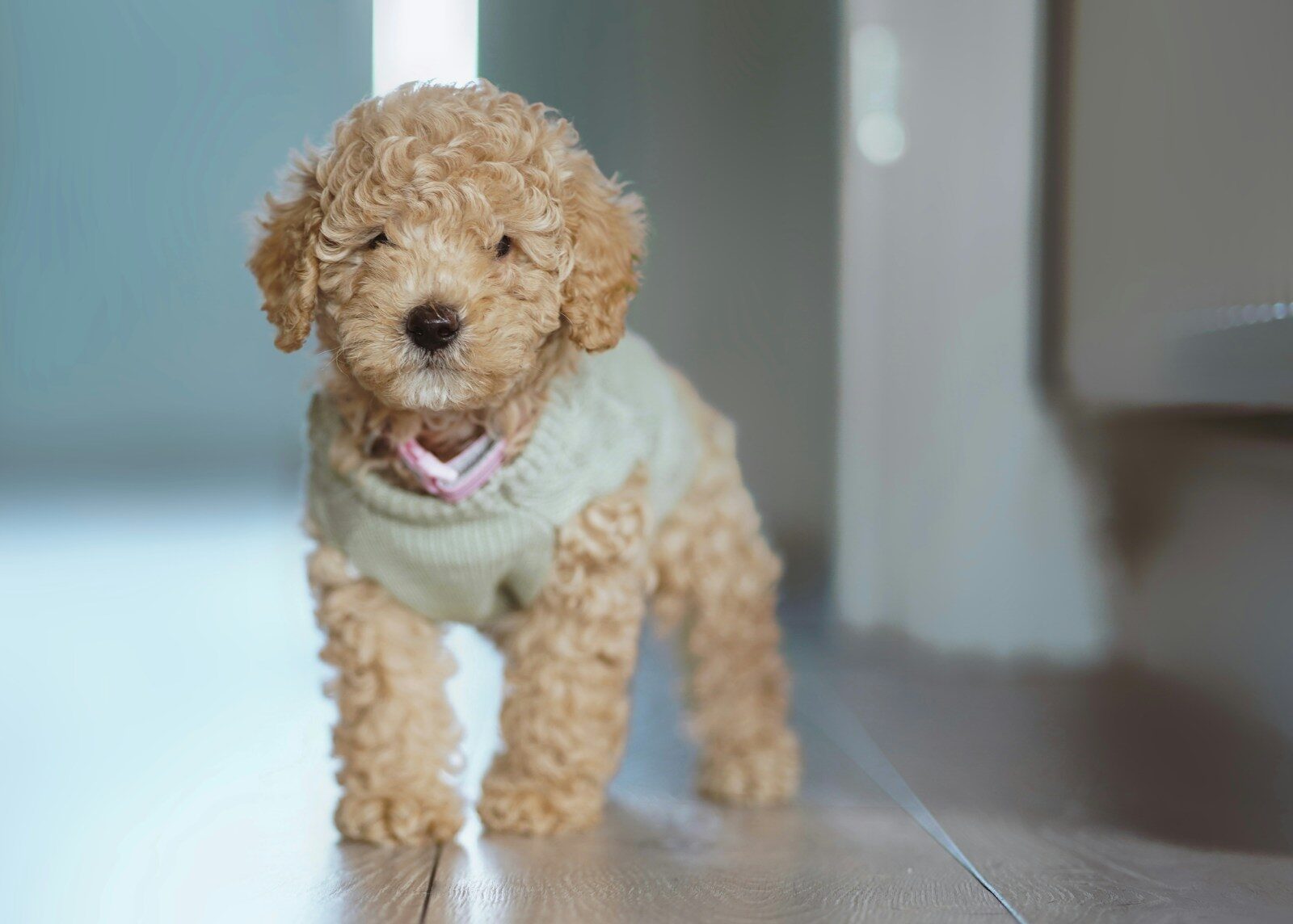
Take three measurements: neck circumference at the base of the neck where it meets the shoulders (snug but not tight); chest circumference around the widest part of the chest, just behind the front legs (snug but not tight); and back length from the withers, which is the base of the neck just ahead of the shoulder blades, to where the tail meets the spine.
The length of a shirt or tank should be approximately three-quarters of the total length of your dog, measured from the collar to the base of the tail.
The chest and neck measurement are the most important, as they must be large enough to go around your dog.
Where only chest measurements are shown, use the chest measurement to select a size, and the length will be suitably proportioned.
If your dog is a longer breed, select one size larger than the chest measurement suggests.
A useful general size chart for reference, based on widely used dog apparel sizing:
| Size | Neck | Chest | Back length | Typical Poodle variety |
|---|---|---|---|---|
| XS | 5.5" | 12" | 7" | Toy Poodle |
| S | 6.5" | 15" | 9" | Small Miniature |
| M | 8" | 19" | 13" | Larger Miniature |
| L | 10" | 24" | 17" | Small Standard |
| XL | 13.5" | 29" | 20" | Larger Standard |
These are reference points only. Measure your dog every time.
Clothing that's too tight can restrict movement and cause chafing. Overly loose garments might lead your dog to trip or entangle.
After putting on any new garment, verify the dog can walk, sit, lie down, and turn around without restriction.
Check that two fingers fit comfortably under the collar opening and the chest band.
Fabric: the most Poodle-specific choice you'll make
This is where clothing for Poodles differs most from clothing for other breeds. The curly coat mats under friction.
The friction from standard dog clothes can quickly lead to painful tangles and knots in a Poodle's delicate, curly hair.
Exceptionally soft and smooth fabrics, such as breathable cotton and gentle cotton-spandex blends, are selected to glide over the coat rather than catching on it.
Synthetic fabrics such as nylon, polyester, and acrylic can cause skin irritation in some dogs, especially those with sensitive skin.
They also tend to trap heat and may not be breathable, leading to overheating. Loose knits or mesh can easily snag on nails, teeth, or other objects.
Cotton dog clothes are ideal for daily wear because they remain light and breathable.
Raised seams can rub against a dog's skin and cause irritation. Clothes that are too tight may trap heat or cause friction.
For a Poodle worn at home regularly, cotton or cotton-spandex blends are the practical first choice.
Fleece is acceptable for warmth in genuinely cold conditions. Anything rough-textured, loosely knitted, or synthetic should be avoided for regular indoor use.
Check for seams inside the garment before buying. Flat seams or seamless constructions cause far less coat friction than raised or overlocked seams.
Safety and fit rules for indoor wear
Check especially around the arms (in the "armpit" area) and around the neck to be sure there is freedom of movement, but not too much excess fabric.
Choose pieces that are easy to put on and take off. The best pieces will have nothing that can be chewed off and swallowed.
Monitor for overheating. Dogs can overheat if they wear too many layers or if the clothing is too thick.
Be especially cautious indoors or in mild weather. Watch for signs like panting, excessive drooling, or lethargy.
Unsupervised wear is a separate risk category. Pieces of clothing can get caught on objects and may lead to your dog getting stuck.
Pajamas and sweaters worn overnight are a particular concern for dogs that move around or jump on and off furniture.
Only buy stretchy ones, so they won't get hurt if it gets misplaced.
Sometimes when you get up, they'll have three legs in and one leg out. But as the material expands, there is no risk of injury.
Avoid anything with buttons, decorative hooks, loose ribbons, or small attached parts that could be chewed and swallowed.
Introducing clothes to a Poodle at home
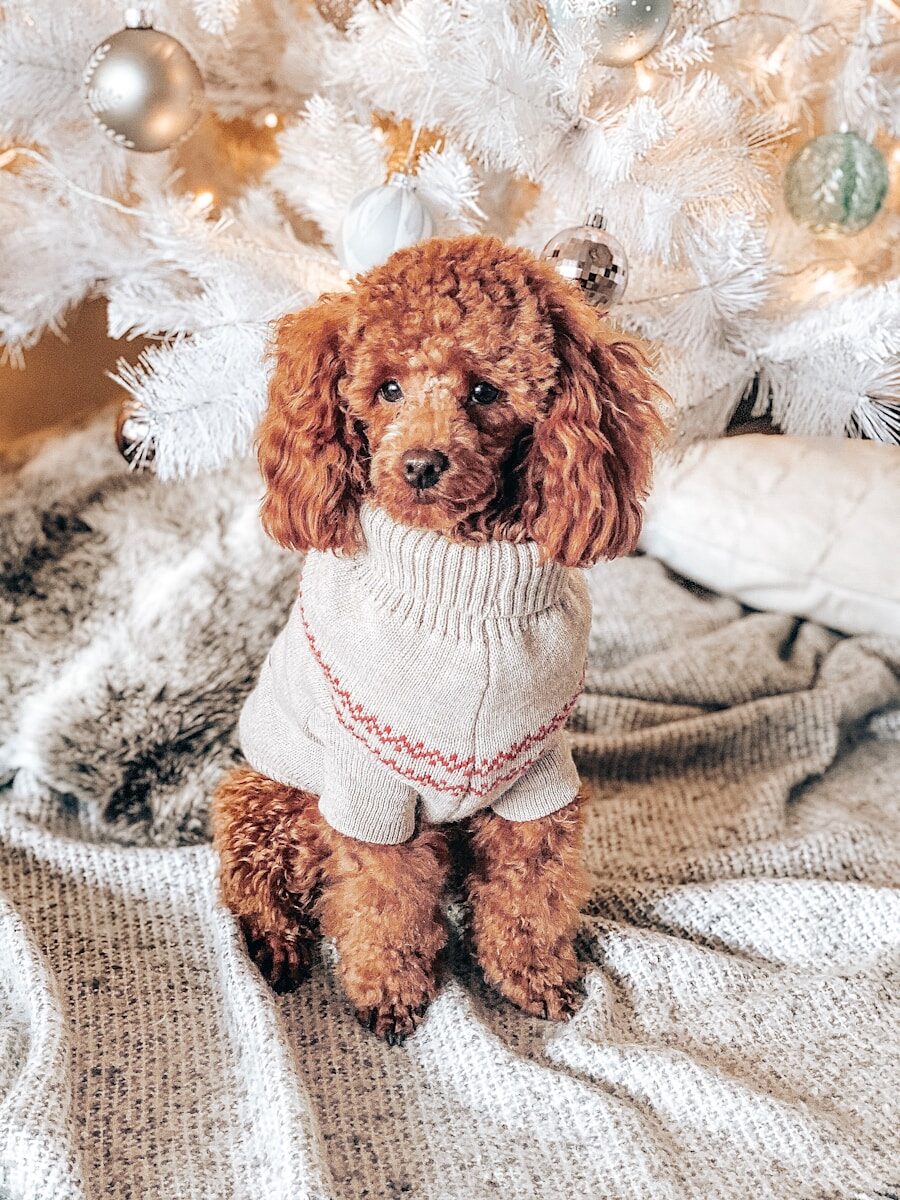
Start indoors. Let your dog wear the coat inside for short periods to get accustomed to the feel.
Use treats and positive reinforcement to create a positive association with the coat.
The standard introduction process: let the dog sniff the item, then drape it loosely over the back for a few seconds while giving a treat.
Follow with one paw through a leg hole, then a short full-wear session of 30-60 seconds.
Extend the duration gradually over several days.
If your Poodle isn't used to wearing clothes, introduce any items slowly.
Adjust the outfit based on the weather to ensure your dog doesn't overheat while wearing a winter coat.
Signs a garment fits and is tolerated well: the dog moves normally, lies down without struggling, doesn't scratch at the item obsessively, and shows no panting or signs of distress.
Signs to remove it immediately: freezing in place, frantic scratching, panting, refusing to move, or attempts to bite the clothing.
Practical clothing types by indoor use case
Lightweight cotton shirts or tanks: everyday indoor warmth for Toy and Miniature Poodles, or older Standards in cool rooms.
Easy to wash, low friction against the coat. The first thing to try if the dog is shivering indoors.
Sweaters (cotton-blend or fleece): for colder homes or post-grooming periods when the coat is very short.
Check for tightness across the chest weekly, as Poodles with growing coats can seem to change size fast.
Pajamas: for overnight cold in rooms below 65°F for small Poodles. Choose stretchy fabrics only.
Don't use if the dog sleeps unsupervised in areas with furniture legs, cords, or objects that could snag.
Post-surgery or skin-protection shirts: cotton t-shirt styles that cover a wound site.
Purpose is to prevent licking and irritation, not warmth. Your vet should advise the exact coverage needed.
Common misconceptions
Size by breed name is enough. It's not.
Two Miniature Poodles of the same weight can have chests that differ by 2-3 inches due to natural variation in conformation. Always measure.
A longer coat makes indoor clothes unnecessary. A long coat does add insulation, but elderly Poodles, dogs with hormonal or skin conditions, and Toy Poodles in cold rooms may still benefit from a light layer regardless of coat length.
Any soft fabric is fine. Soft to the touch isn't the same as low-friction.
Some knitted fabrics that feel soft on human skin will still catch on a curly Poodle coat.
The test: run the fabric slowly across the back of your hand with light pressure.
If it drags or pulls, it will do the same to the coat.
Dog clothes are always seasonal. For elderly Poodles or those with illnesses that affect thermoregulation, indoor clothes may be a year-round practical item regardless of outdoor weather.
References
- Poodle Club of America, Sizes of Poodles: https://poodleclubofamerica.org/sizes-of-poodles/
- PetSmart Dog Clothes Sizing Chart: https://www.petsmart.com/help/sizing-charts-H0012c.html
- PetMD, Do Dogs Need Sweaters in Winter: https://www.petmd.com/dog/seasonal/evr_dg_sweaters_for_dogs
- Voyagers K9 Apparel, Miniature Poodle Measuring Guide: https://k9apparel.com/pages/miniature-poodle-measuring-guide